

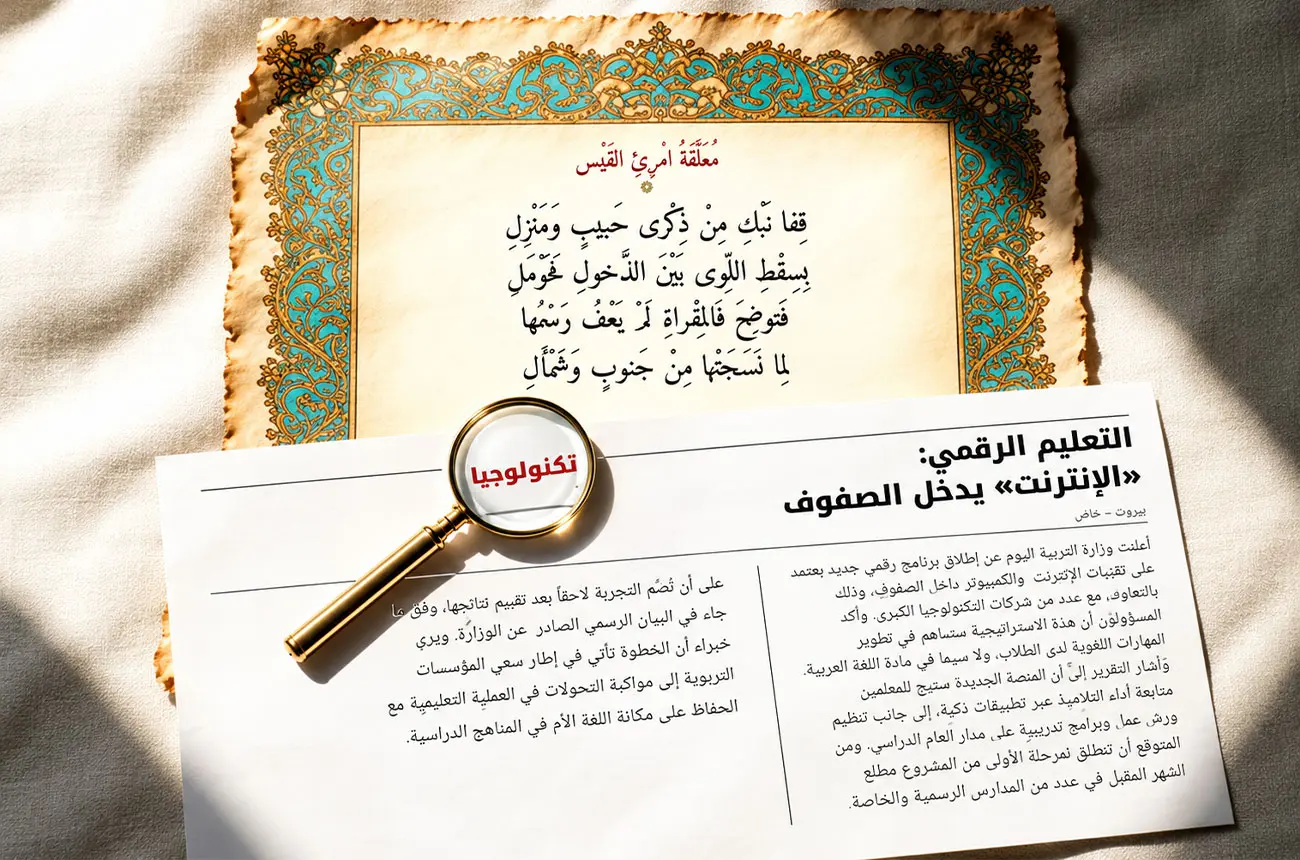
A closer look at what we mean when we call today’s Arabic “the pure language.”
Mohamad Jawad Hamieh | Saifi Institute for Arabic Language
The world is in constant flow, governed by an ongoing state of becoming. Nature and its products, including human beings, are subjected to this state. People are meant to adapt, the societies where they live too, and, by extension, their systems of thought and communication. Abd al-Qader al-Maghribi, a co-founder of the Arab Academy of Damascus, views Arabic as a sociological organism that evolves and grows just like people. This phenomenon is not a matter of controversy; Arabic did evolve. However, distinctions concerning the nomenclature ought to be made.
“[And] taught him [man] eloquence.” (55:4 Quran). In this verse, eloquence is the equivalent of “Bayán”, a concept that is almost always linked to “Fuṣḥā” as far as Arabic dictionaries are concerned. Bayán which roughly translates into “clarity” lies at the core of Fuṣḥā. But as the Quran was meant for Arabs that lived over a thousand years ago; “Indeed, we have sent it down as an Arabic Qur’an that you might understand.” (12:2), one might ask; is the “Fuṣḥā” we speak today eloquent, beautiful and clear enough that those Arabs would have found it captivating and compelling?
To find an answer, in light of the most common definition of Fuṣḥā: “The language of the Quran and literature.” The matter should be examined at various levels, with aesthetics being one of them. The field of aesthetics is mainly concerned with beauty. According to Plato, beauty is goodness and every beautiful thing is good. This view has influenced Islamic thought in a way. To Muslims, beauty is perceived through the values of righteousness and correctness, hence, the Quran which is believed to be inspired, revealed and flawless, has emerged as the standard of linguistic aesthetics.
The Quran presents sublime stylistic techniques which range from alliteration to allegory, and is very musical with a predominant value given to rhythm and rhyme. In comparison, texts produced these days seem mundane and lacking the aesthetic spirit. The musical charm of the Quranic language, carefully curated through ornamentation and use of elegant diction, greatly impacts the power of rhetoric it holds. This effect is significantly weakened in today’s literary work, which makes its Arabic less of a Fuṣḥā, one that is definitely incapable of capturing pre-Islam Arabs’ attention.
Another widely spread definition of Fuṣḥā is that which describes it as a language “sound, pure and devoid of defects” that it is: not “desecrated” with any colloquial or foreign term. So, Fuṣḥā gained with the uprising and spread of Islam an aura of holiness which became, with time, integrated in its nature, and marked the difference between it and every other version that might later be engendered. This fate, however, was imminent; the Islamic dominion expanded beyond the borders of Arabia so much that linguistic and cultural contact became inevitable in the Arabicized region.
Not only did this contact affect phonetics and pronunciation but also vocabulary; new words stemming from various cultures and languages were integrated into everyday language. Moreover, the rising interest in the fields of philosophy and different sciences during the times of the Abbasid caliphate led to a massive movement of translation. This introduced a plethora of Greek words in various works of philosophy, medicine and astronomy. This trend resurged during the Arab Renaissance where the need for a simplified and more technical language emerged. This further diminished Arabic’s purity.
By this reasoning, one can realize that two of Fuṣḥā’s key aspects had been tampered with, so to speak. The fact that style and purity had significantly changed led scholars to distinguish between Classical/Quranic Arabic — also known as Al-Fuṣḥā Al-Turathiya — and Modern Fuṣḥā (al-Haditha), more commonly referred to as Modern Standard Arabic, which is widely used today as a language of media, speech and even literature.
It effectively is not Fuṣḥā after all.
Ready to Start Learning Arabic in Beirut?
Whether it is Formal Arabic for reading, writing, and media, or spoken Lebanese Arabic for everyday life, Saifi Institute builds your foundation with structured, level-based courses in Beirut and online.